Home » Headline, Humor, Picture of the Week

Uyghur Hunk causes Internet Sensation

July 8, 2011 One Comment

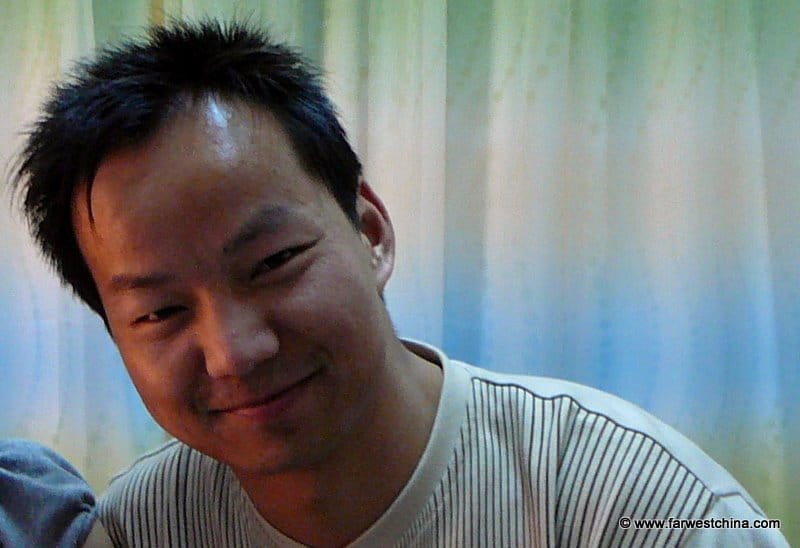
A handsome Uyghur bread maker from Xinjiang

What happens if a lowly Uyghur bread maker looks like he should be modeling for an Asian clothing designer or starring in a movie? As 22-year old Xinjiang native Litahong is finding out, you instantly become a star on Weibo, China’s Twitter-clone. Currently Litahong – a.k.a. “Uncle Flatbread” makes about 5,000 RMB per month (US$773) selling his food in the Zhejiang province, but if he can capitalize on this 15 minutes of fame you never know.

And I’m sorry to break it to you, ladies…he’s returning to his hometown of Yengisar (near Kashgar) to get married in August. Too bad.

For more read China Daily’s story: Uncle Flatbread latest Internet Sensation

Home » Headline, riots, Unrest

Urumqi Riots: 2 Year Anniversary

July 5, 2011 18 Comments

It was two years ago today that the streets of Urumqi, capital of China’s Xinjiang province, were filled with protesters, police, riots and burning cars.

It was two years ago today that almost 200 people died and hundreds more were wounded.

It was two years ago today that text messaging in the province was disabled and the internet was cut for a record 10 months.

It was two years ago today that the fight between the Han and Uyghur cut so deep that the scar will likely never disappear.

I remember this day just like it was yesterday. I remember the frantic phone calls from friends, the police marching down the empty streets wearing riot gear, and for the first time not a single car, taxi or bus ferrying people from one place to another. We all just locked ourselves in our homes and waited for time to pass.

The Blame Game

That day still remains clouded in confusion. I was there when it happened and I don’t fully understand what transpired, yet somehow the government, human rights groups, and scores of journalist tell me they know exactly what happened. And what’s worse, each of them have videos to “prove” their side of the story.

Who am I supposed to believe? The government has a bad reputation when it comes to re-writing history, however the international Uyghur groups have done themselves no favor by insisting that the 150+ Han bodies that lay dead in the streets was a justifiable retaliation for “excessive force” from the police. The crackdown that has happened since July 2009 is worthy of outrage, but the riots themselves? I still hold that both groups were equally at fault.

Urumqi Riots Timeline

If you’re not quite sure what happened in Xinjiang during the month of July 2009 or if you need a refresher, here’s a look at the events that took place:

Home » Books, Headline

The Horse that Leaps Through Clouds: A Book Review

June 28, 2011 4 Comments

Horse That Leaps Through Clouds by Eric Enno TammThe Horse That Leaps Through Clouds
Counterpoint Press (US$30)
by Eric Enno Tamm
Review by Josh Summers

‘History does not repeat itself, but it rhymes” Mark Twain once quipped. Such is the theme of The Horse That Leaps Through Clouds, the latest book by author Eric Enno Tamm that is blend of historical non-fiction and personal travel narrative. Retracing the steps of Baron Carl Gustaf Emil Mannerheim, one of Finland’s most respected statesmen, the author journeys across Central Asia and into China to discover if the world’s current perception of China’s seemingly meteoric rise is reality of if, in fact, it is merely a rhyme of what has been said over the past century.

In the company of names such as Sven Hedin, Aurel Stein, Albert Von Le Coq, Paul Pelloit and others, Baron Mannerheim is one of the lesser-known chess pieces in what has been named The Great Game. Indeed his journey was no more heroic than that of most merchants at the time and the impact his findings were minimal at best; nonetheless, the fact that we have a record of an important era in Chinese history written by “the greatest Finnish person of all time” is quite intriguing.

The Silk Road: Past and Present

A photograph of Baron Mannerheim in 1940In July of 1906, Mannerheim set out from St. Petersburg to travel to Beijing as a spy for Russia. Like every other explorer along the Silk Road at the time, he was forced to overcome difficult terrain, harsh weather and unpredictable politics all for the sake of “gathering intelligence”. His account of the journey, although it lacks a certain amount of passion and emotion, paint a beautiful picture of the Asian continent, from its remarkable terrain to its unknown people groups.

Exactly 100 years later Eric Enno Tamm boarded another Russian train with Mannerheim’s writings in tow.  He sought to visit the same places, experience the same adventures, and find the same ethnic minority groups that would help tie these two trips together. A century separated them, but their observations on China, Tamm concludes, are eerily similar.

A Personal Opinion

I admit that I approached this book with a bias toward the Xinjiang chapters. I imagined myself standing in each location and enjoyed looking at the province through the eyes of a first-time visitor. I was especially fascinated by his focus on foreigners – both past and present – who resided in Xinjiang and their reasons for doing so. His interviews with cafe owners, bloggers (not me, unfortunately) and a select few locals gave quite a few different perspectives on expats in the region.

Still, even in these chapters and especially throughout the rest of the book, I was keenly aware that this trip was both Mannerheim’s and Tamm’s first trip into Asia. In this, like many other things, the two men are alike: neither spoke the local languages – including Mandarin. Neither spent more than a week or two in one location. Both of them made sweeping general statements about people and cultures in which they had very little experience – a few of which I disagreed with.

In the end I believe this book succeeded in tying together two separate journeys and offering insights into China’s past, present and future. For most travelers, this book has the wonderful ability to transport you either to a place you’ve never been or to memories you’ve already made while providing a historical backdrop for each location.

As you read, though, keep in mind that the opinions expressed are the result of two, one-time journeys. Even Mannerheim noted in his memoirs and Tamm repeated: “After three weeks in China one is prepared to write a book about her, after three years an article, but when one has been her thirty years one realizes that one knows nothing”.

I couldn’t agree more.

————————————————–

**Learn More about The Horse That Leaps Through Clouds**

Home » Food, Headline, Picture of the Week, uyghurs

Tasty Uyghur Treat: Pic of the Week

May 13, 2011 4 Comments

A tasty Uyghur sweet being sold in the Kashgar market

“Sweets at Kashgar Bazaar” by Stephen Lioy

A brief description from the photographer Stephen Lioy:

“Though they can be found throughout China, these Uyghur sweets somehow taste best when traveling through Xinjiang.  At the bazaar in Kashgar, this stuff was so sticky that it ripped the braces right off the back of my upper teeth.  It was so good that, the damage already being done, I finished the rest of it anyways.”

Stephen Lioy is a student turned teacher turned traveler. He is currently homeless and unemployed, and quite happy with it. Read more at www.monkboughtlunch.com to see why.

- – – – – – – – – – – – – – – – – – -

If you are interested in contributing a photo to FarWestChina’s Picture of the Week series, please contact me and send in your Xinjiang-related photo. All photos must be originals and will be credited to you and/or your personal website.

Home » basketball, Headline

Playing Basketball in China…Worth it?

May 10, 2011 4 Comments

The Xinjiang Flying Tigers basketball teamHow much would somebody have to pay you before you gave up the right to use your TV and cell phone? How about your right to stay up past 10pm at night? It may sound strange, but in order to play professional basketball in Xinjiang – whether you’re Chinese or American – you have to give it ALL up.

Over the past few years it has become a growing trend for struggling NBA stars in America to find money and prestige playing for the Chinese Basketball Association (CBA). Players like Quincy Douby (formerly of Toronto Raptors) and James Singleton (formerly with the Washington Wizards) wandered all the way out to the westernmost province of Xinjiang for just that reason. And it works.

Since the drafting of Douby and Singleton, Xinjiang has made it to the CBA finals for three years in a row. While they have yet to win a title (losing to Guangdong again this year) they still remain highly competitive.

Restrictive Rules for Players

Check this out, though: According to this report (translated from this Chinese website) there are incredibly strict rules for CBA players in Xinjiang. Here are just a few that blew my mind:

  • Ban cell phonesDuring the season, NO TV
  • During the season, NO Cell Phones (they must be handed to the head coach)
  • Lights out by 10pm, and a coach apparently checks.
  • If you want to leave the “team compound”, you must first get permission.
  • No alcohol.
  • You are forbidden from talking to the press.

There are more, but this should be enough to drop your draw like it did mine. Honestly, Douby and Singleton either really love basketball or they are being paid a boatload of money.

Would you move your family to Xinjiang and give up all this for money or fame?