Anatomy of a Modern Chinese Wedding
My dad once told me that in order to fully understand a culture you need to attend a wedding, a funeral, and a baby shower. Unfortunately our Chinese friends never got that memo, so instead of a well-balanced cultural immersion, we were invited to five (yes, count them…FIVE) weddings in a month.
We’ve been to many Chinese weddings before, but until now we haven’t had a chance to share our experience.
Please keep in mind as you read that we are referring to a modern wedding, not any ancient wedding practices, and we are drawing only from personal experience and what we’ve asked friends.
China is a big country therefore many celebrations and customs differ in different areas, so this might be very specific to Xinjiang.
The Beginning of a Chinese Marriage
The part of China’s marriage process that brought me the most confusion at first was trying to figure out when a marriage begins.
The confusion stems from the fact that many times we have learned about a pregnancy before we are even invited to the wedding.
In places other than China you might assume that they are getting married because they are pregnant, but in China there is a possibility that they have already been married for quite some time – they just haven’t had a wedding.
A marriage officially begins in China when a couple apply for and receive what is roughly translated as a “marriage book“. It’s basically a marriage certificate as we know it, except it looks more like a passport with the couple’s picture in it, hence calling it a “book”.
After a couple fills out a load of paperwork they go to the appropriate government office and apply to be married. Thirty minutes later they are handed their little red book – the beginning of the marriage.
Many couples wait months after receiving their marriage book before they actually have a wedding, a period of time which many times is used to decorate their new home.
We’ve seen some couples live together during this time, but we’ve also seen couples wait until after the wedding to move in together. It seems odd, but this “limbo” period is the reason that often times we hear of a pregnancy before a wedding date is announced.

Inviting Guests to a Wedding in China
Once they’ve actually decided to have a wedding they begin to make all the arrangements and invite the guests. We usually receive wedding invitations about a week in advance, but some couples have actually been kind enough to give us a month’s warning.
The two invitations you see below were given to us 4 days before the respective wedding dates. We went to both, which begs the question “Do you have nothing to do in your spare time?!” and, well…
…we refuse to answer that question.
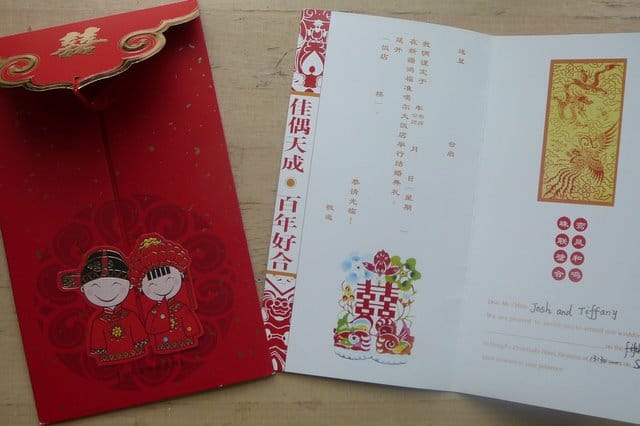
Many invitations we received were actually “floating invitations”, which means that they haven’t nailed down the date yet but want us to know they’ll be getting married.
I’m sure things are different in the bigger cities, but out here in the boondocks they actually have wiggle room on dates.
Actual Chinese Wedding Ceremony
Ok, here comes the fun part.
There’s a lot that goes on before the wedding at the bride’s house, but that’s a whole different story for a whole different post. Believe it or not, we actually enjoy going to Chinese weddings, eating the food and getting together with our co-workers for the big party.
And it is a party. Since they’re already married by the time the wedding occurs, the only part of the proceedings which could be considered ceremonious would be the public reading of the marriage book to verify that the couple is, in fact, married.


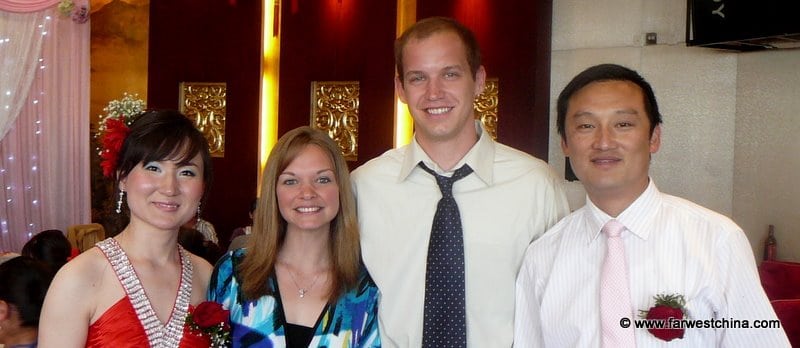
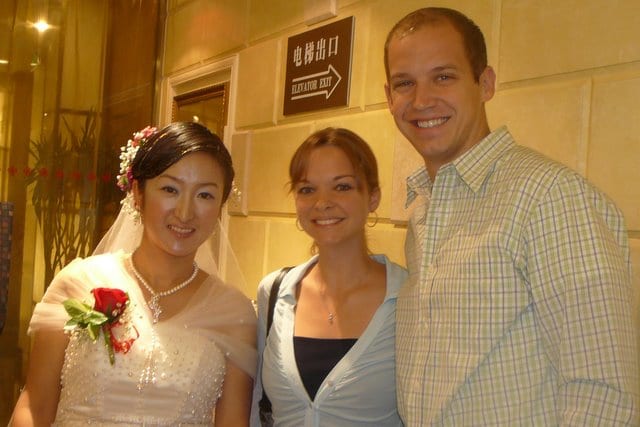
Sorry, I’m actually getting ahead of myself. First things first. When we arrive at the banquet hall we’re usually greeted at the door by the bride, groom, best man, and bridesmaid.
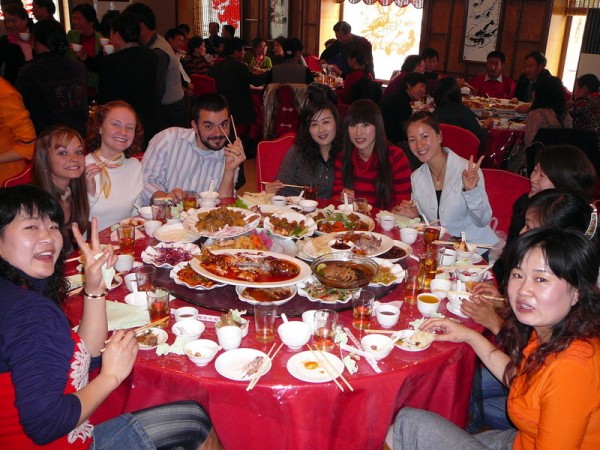
Pleasantries and congratulations are exchanged (along with a picture, sometimes), we sign a guest book, and then we just sit at the banquet tables and chat with other guests, eating the customary plate of peanuts and sunflower seeds.
Once most of the guests are seated, the real party begins. It would be pretty boring to give you a play-by-play of the wedding, so instead I’ll give you a quick list of things that we’ve noticed are similar and unique to a Chinese wedding.
As you’ll see, the modern Chinese wedding has tried its best to imitate foreign weddings and yet twisted those customs to create their own interesting celebration.
- Similarity: There is big fanfare when the bride enters the room. Difference: In America, we play a song, in China, they light Chinese fire crackers. They’re done outside the restaurant, but they’re usually right outside the window. I’ve lit them once (see picture to the right), and they are death to the ears at close range. They say it’s supposed to drive away evil spirits, but I think they just love the loud sound.
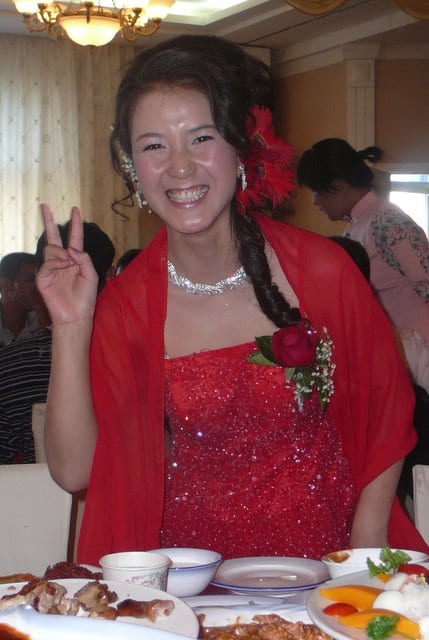
- Similarity: The bride wears a white dress. when you first arrive. This practice is relatively new in China, I believe, because the traditional color for weddings is red. Difference: She seems to want to get out of the white dress as fast as she can! I’d venture to estimate that the first 20 minutes is spent in the white dress while the remaining few hours and after-party are spent in her red dress.
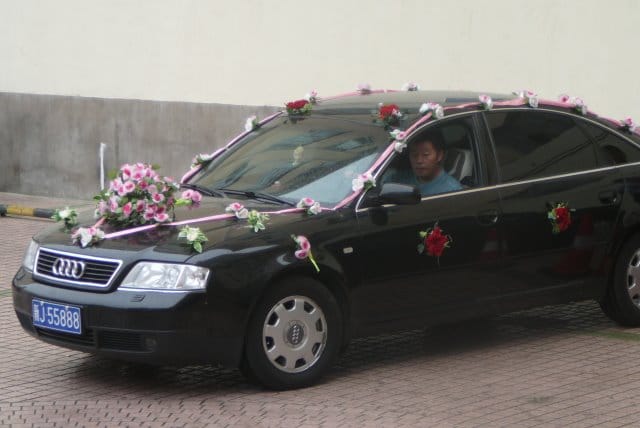
- Similarity: There is a decorated car that the bride and groom ride in. Difference: They arrive in the decorated car (ALWAYS a black car), and it’s usually tastefully done with roses instead of shoe polish and balloons. I honestly don’t know if they leave in the car because we’ve never stayed long enough to figure that out.
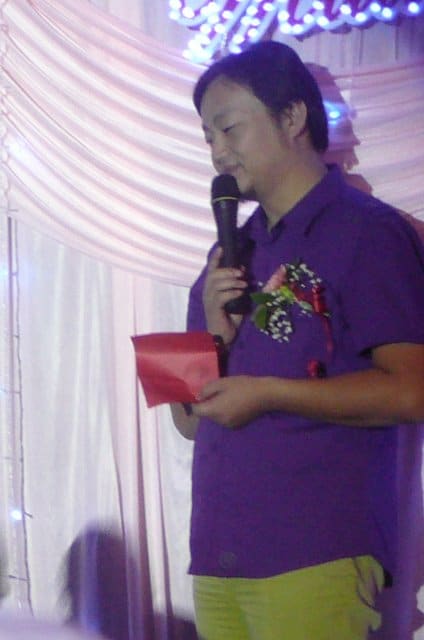
- Similarity: There is an emcee. Difference: He is neither a pastor or a judge. He doesn’t have to be because by this time they’re already married, remember? He’s an entertainer and his job is to make the crowd smile and laugh until they are sufficiently drunk to do so on their own. And if you were wondering…no, our camera wasn’t malfunctioning. The man pictured here is actually wearing green pants and a purple shirt. I have a feeling he actually thought he looked good wearing them, too.
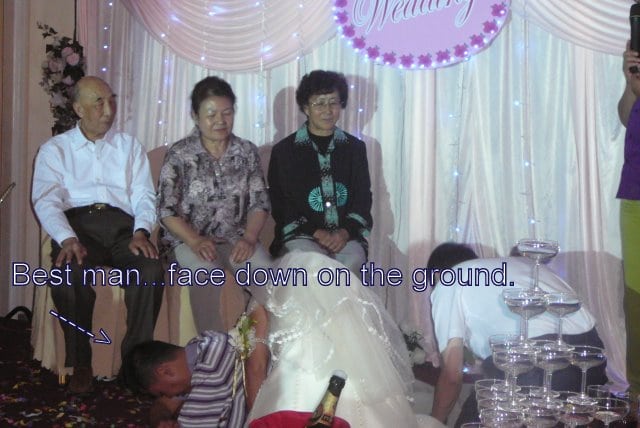
- Similarity: There is a Best Man and a Bridesmaid. Difference: They’re pretty much there to bear the brunt of the emcee’s jokes so that the bride and groom don’t have to. They eat and drink nasty stuff, endure public humiliation, and at some point in every wedding I’ve been to, the Best Man ends up face down on the ground. I never quite understand why.
- Similarity: The music. You’d probably be surprised by how much music you’d recognize at a Chinese wedding. I don’t think they understand what words are being sung, but they realize that it’s a love song and you’re supposed to hear it at a wedding.
- Difference: The next song is Beijing Opera. Ouch. If you’ve ever heard Beijing Opera you understand why this is something that would NEVER happen in an American wedding.
- Similarity: You give a gift to the bride and groom. Difference: You never give anything except money. There is never a gift table, and the term “gift registry” has been difficult for us to translate into Chinese. They usually don’t get married as early as we do, so there isn’t as much need for housing appliances. The money usually goes to pay for the cost of the wedding, but from what I’ve heard it never fully covers the cost.
We, of course, weren’t married in China, so I concede that these are merely observations from a spectator’s point of view. For any readers that have actually been married in China, I’d love to hear what you think of my analysis and what you might add to it. This is by no means a comprehensive overview, but it’s the best I could do for now.
Check out a similar article about another great Xinjiang event: the Uyghur wedding.