

Kashgar’s Old City | Traveler’s Guide to an Evolving City
Kashgar’s Old City has been known for centuries as a unique ancient city in Central Asia. Most know the place for its Silk Road charm, mud-brick houses and friendly Uyghur neighborhoods. Kashgar’s Old City history has been resilient in the face of passing time, but there are few places in the world that are immune from modern development.
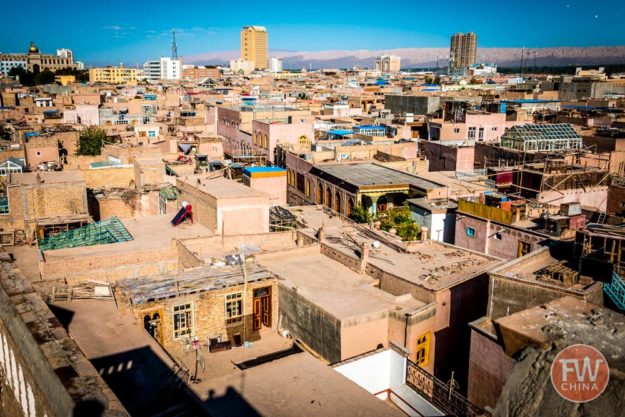
Much has changed in Kashgar over the past decade including the tearing down of the Old City and the rebuilding of a newer, safer Kashgar. It’s hard to tell what’s really been happening in Kashgar over the past decade though, due to conflicting reports between Chinese and international media.
Has the “new” Kashgar Old City been rebuilt now? Is there anything left of the “old” Old City? And if so, how do they compare?
Whether you’re doing research on the history of Kashgar’s Old City or if you’re planning a trip there as a traveler, I’d like to take a chapter out of the FarWestChina Xinjiang Travel Guide and share with you everything you need to know about the famous Silk Road destination.
Kashgar Old City Tour [Video]
As we begin, I invite you to join me on a tour of the Old City of Kashgar. Walk through a short history of the city as well as the changes that have been made with the modernization.
Check out more amazing Xinjiang videos on the FarWestChina YouTube channel!
Now that you’ve watched the video above, we’re going to take some time to walk through a timeline of the changes that have happened to Kashgar’s Old City which, when combined with pictures, should give you a good idea of what has happened..
History of Kashgar’s Old City | Pre-2009 Development
Prior to 2009, Kashgar city center was a beautiful mess of narrow alleyways that snaked in a seemingly chaotic pattern of directions. It was easy for travelers to get lost in the maze and that was part of what made a visit to Kashgar’s Old City fun.
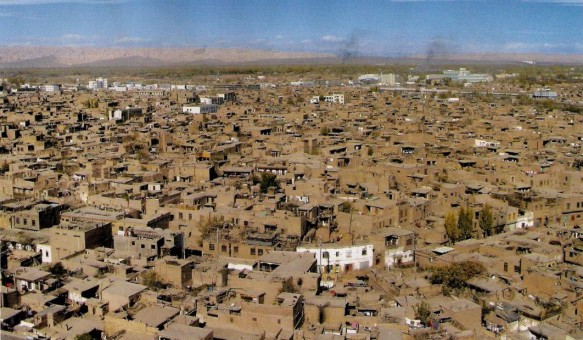
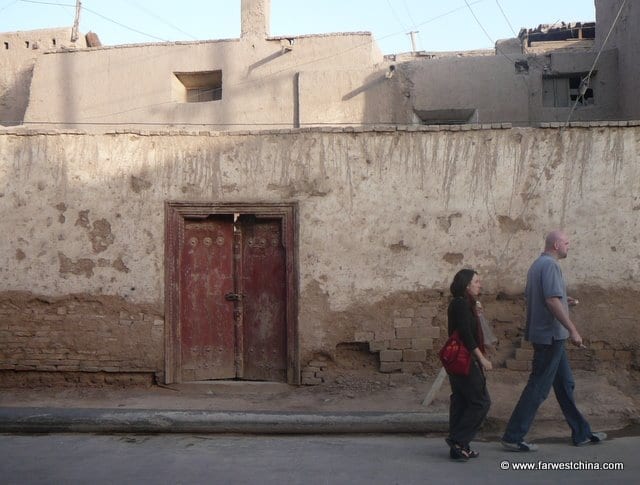
The mud-brick alleyways were quaint and, as I remember them, quite enjoyable to walk through. Yes, they looked old, but there was never the impression that they were falling down.
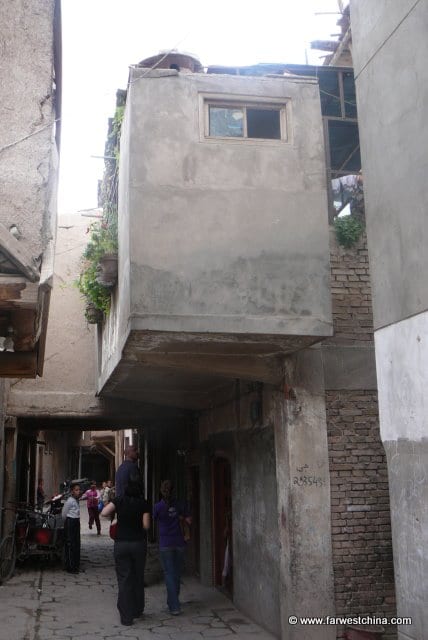
There used to be a city wall that surrounded this central part of the city, but since the early 1920s that wall was torn down. Only a small portion of what is known as the “Liaoning” old city on the west side of Kashgar has a wall that remains to be viewed.
Up until 2009, most of Kashgar’s development had taken place south of town, where large high rises and modern communities had been built up. Even the new train station that connected Kashgar and Urumqi was built out east of town instead of near the center.

2009 | Demolishing Kashgar’s Old City
In early 2009, it was reported by government officials that Kashgar would be demolishing the old city and replacing it with a more modern, tourist-friendly city-center. At the time, I don’t think the government had any clue that this idea would cause such a backlash from the foreign community.
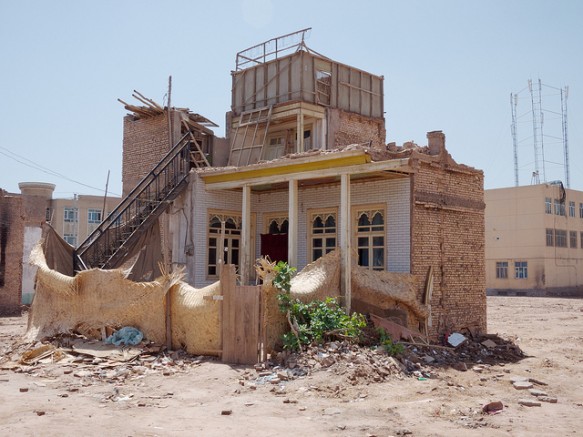
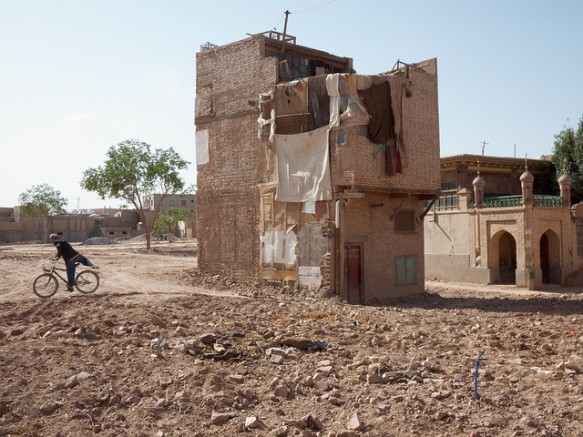
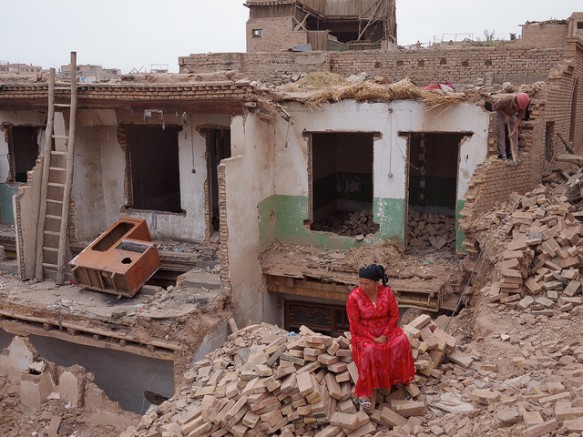
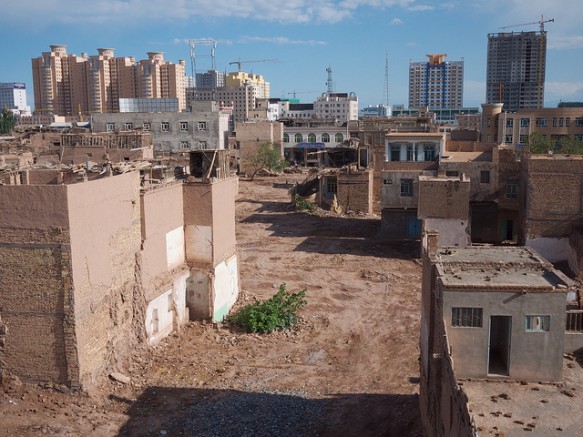
Newspaper all across the globe published stories with excellent photos covering the demolition during the first half of 2009.
It seemed that China was going to follow through with their plan to demolish Kashgar’s Old City. Initially, China claimed that the demolition was for the safety of the city residents whose mud-brick homes were considered dangerous in the earthquake-prone Kashgar area.
While it’s true that Kashgar is prone to earthquakes, the idea that buildings which had stood for centuries had all-the-sudden become “unsafe” didn’t seem right.
There were other factors at play, and although I don’t believe that China was purposefully trying to squelch the Uyghur culture (the true heart of Kashgar’s Old City), there was still plenty of outcry from the Uyghur diaspora.
Strangely, following the first half of 2009, there was almost complete silence from Kashgar. With the exception of artists renderings of what Kashgar was supposed to become, nobody knew what actually happened.
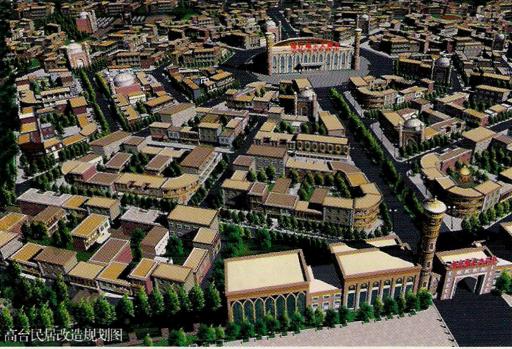
As it turns out, these artist renderings were a bit ambitious.
2009 – 2018 | Kashgar’s “New” Old City Takes Shape
It’s funny how some construction projects in China seem to go at lightning speeds, while others roll along at a snails pace. For Kashgar’s Old City, it was more of the latter.
Small sections at a time of the old city would be demolished and replaced with wider streets, concrete buildings and some semblance of a tourism strategy. It was never clear exactly how much of the city would be torn down and what the new city would look like.
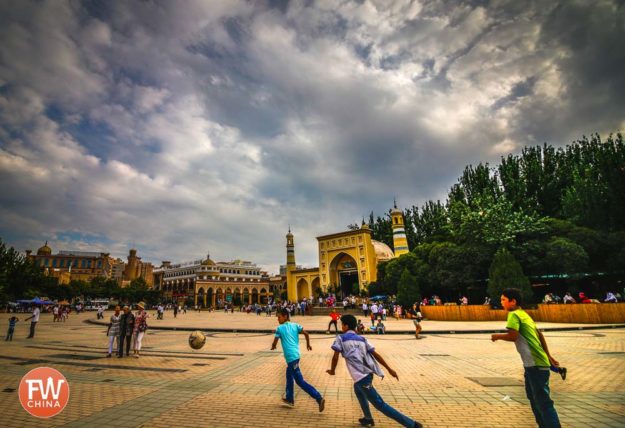
Throughout this time, the local Uyghur people were given a choice of moving out to new community developments on the outskirts of town or waiting to purchase a place in the “new” old city. Keep in mind that most of these people were born and raised in the Kashgar Old City and the thought of moving out, even to a place with more modern conveniences (reliable electricity, central heating & plumbing).
At one point in late 2010, one traveler named Stefan Geens took stock of what was left and created a map to show the slow process of demolishing and rebuilding that was taking place.
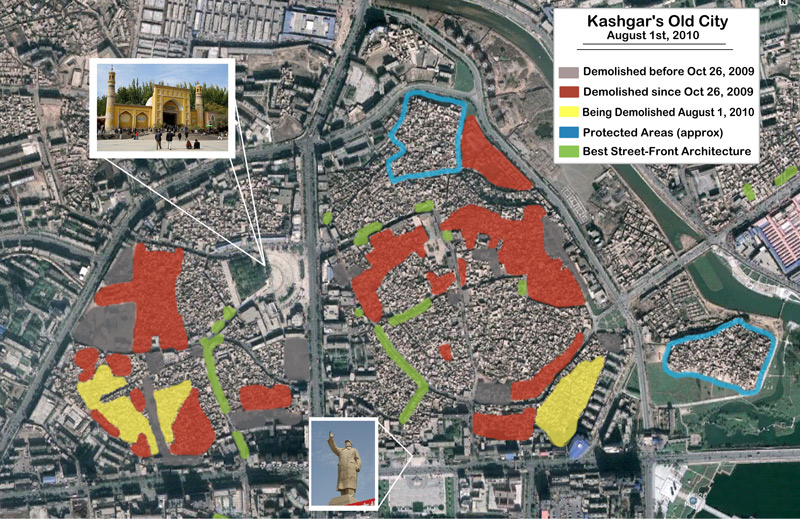
As you can see, the demolition was done in phases and there didn’t seem to be any rhyme or reason to it.
2019 | The Unfinished Kashgar Old City
Fast forward to 2019. A small number of bulldozers can still be found chipping away at parts of Kashgar’s Old City but, by and large, the demolition is mostly over.
Most of the Old City has been rebuilt with wider streets, more modern architecture and plenty of concrete. There’s little resemblance to the pre-demolished Kashgar, but it’s surprisingly charming.
Local Uyghur people have moved back in and there are children playing in the streets. Shops are open and the night market still comes alive in the evenings.
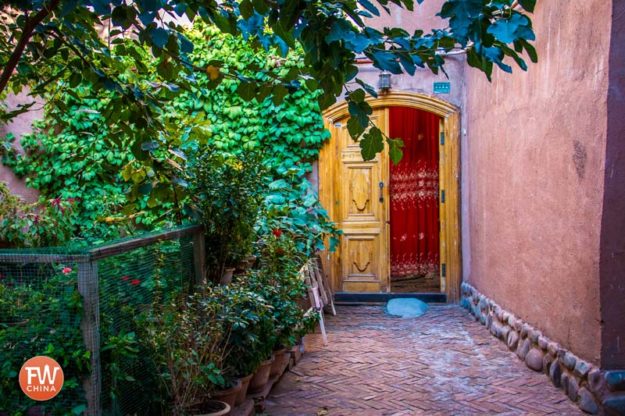
And then, of course, there’s the small bit of “old” Old City on the eastern edge of town, just north of the lake. The government at one point had kept this area as “protected”, which means they weren’t going to tear it down.
Alas, that was too good to be true. As of early 2019, even this portion of the Old City is now off-limits and is slowly being torn down. These photos were taken prior to everything being torn down.
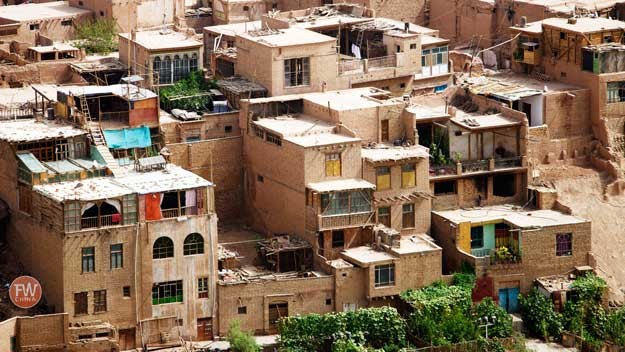
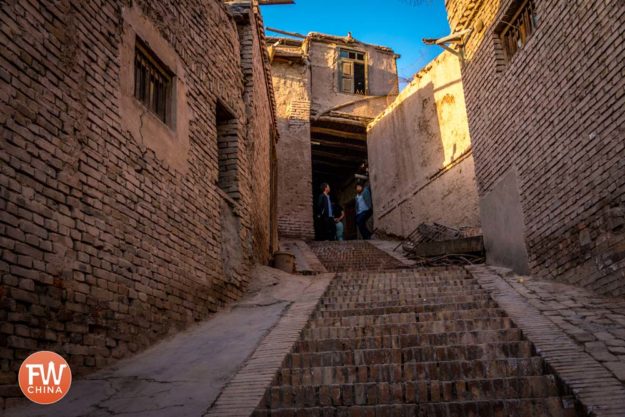
There’s plenty to see when you come to Kashgar, that’s for sure, but much of it feels unfinished.
Conclusion | Should You Visit the Kashgar Old City?
So this naturally begs the question: “Is it worth going to visit Kashgar and its Old City”?
That’s an excellent question. First, let me answer by repeating what I’ve said all along: the heart of a city is not in the make up of its buildings but in the makeup of its people. Kashgar is still a Uyghur town full of friendly Uyghur people and for that reason, it’s still worth visiting.
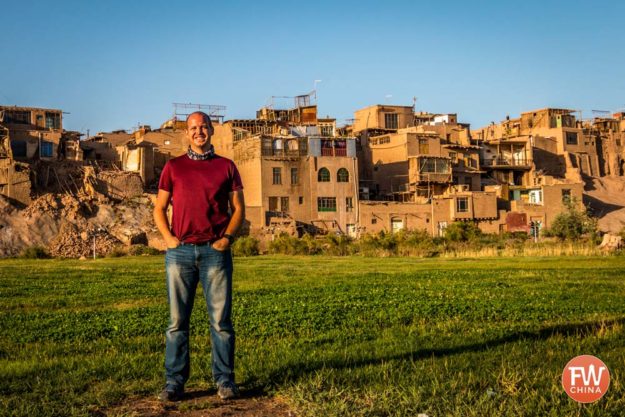
Like I said, the new Old City, despite its lack of history, is still charming. I still enjoy meeting people in the streets and visiting the various stores along the way. You can even take time to see Uyghur tightrope walking, known as “dawaz”.
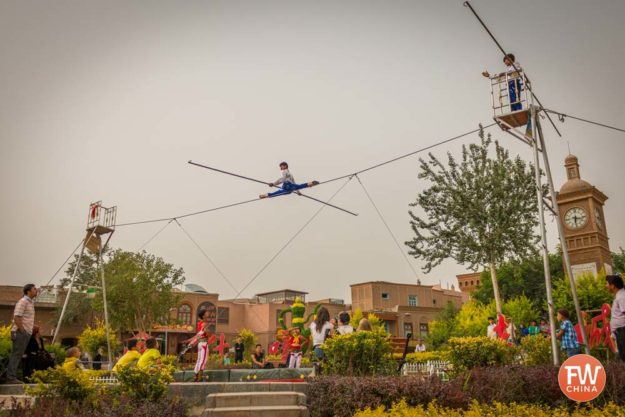
But if you’re looking for an authentic view of Silk Road history, you might come away a bit disappointed. It exists, don’t get me wrong, but it’s not what it used to be.
Yes, visit Kashgar – heck, there’s much more to see beyond just the Old City! – but be aware that changes are being made. Development is happening.
And keep in mind that Kashgar’s “new” Old City is still a work in progress.



Where would you go now then, for the authentic Silk Road?
[Reply]
Josh Summers on October 16th, 2017 at 10:36 pm
Kashgar is still a fun experience, but if you’re looking for older-looking places, you just go south toward Khotan and further along the southern Taklamakan Desert. Just be aware that the security is much tighter down there.
[Reply]
Josh, when you say security is a lot tighter in Khotan, what do you mean? Can i travel there? I want to visit fabric weavers
Thank you
[Reply]
Josh Summers on May 17th, 2018 at 6:52 pm
You can definitely travel there, just be warned that you’ll run into a lot of police and a lot of checkpoints.
[Reply]
I am happy to see this website.
I have visited Kashgar from Karakoram Highway in July, 2018.
I was impressed the development of Kashgar, although I could not walk around very much due to heat exhaustion.
I particularly appreciate your info because I am worried about too much misconception of the press. Recently, there were harsh China-bashing on abusing human rights of the Chinese-Muslims. While I admit that there were too many Police officers at Idkar Bazaar, I do not believe that Chinese government is not at bad.
I hope that positive information of Kashgar like yours may help foreigners better understand the small city on the New Silk Road.
Sincerely
[Reply]
Josh Summers on October 1st, 2018 at 4:27 pm
I’m glad you found it useful. I want to be clear about something, though: I do want to present Xinjiang in a positive way. However, having lived in Xinjiang for over a decade, I can tell you that everything you’re reading in the news about what China is doing is TRUE. China is doing terrible things to both me and my friends. I still love Xinjiang, but I am very opposed to what China is doing here.
[Reply]
Hi Josh
I was amazed when I came across your site. What a wonderful thing to do to write a blog on Far West China. I think you’ve done an amazing job.
I really liked this article on Kashgar’s timeline particularly pre-2009 and your commentary on the demolition, which is why I linked to you in my article on Kashgar’s Sunday Market in 1995! (https://breadtagsagas.com/kashgar-sunday-market/). I also enjoyed your video which brought back good memories.
As you’ve lived there since 2006, it must be hard both to travel and live in Xinjiang today but even harder on the locals. I wish you well!
Kind regards
Tony
[Reply]
Josh Summers on November 4th, 2018 at 7:13 am
Thanks, Tony! Great article on the Sunday market :)
[Reply]