Healthy Chinese Food? It’s not the Food, It’s This…
Is Chinese food healthy? Although there’s something to be said for China’s excellent use of vegetables and limited use of sugar in their dishes, that’s not the whole story. Having lived in China for the past decade, I’ve discovered that there other factors that contribute to the notion of “healthy Chinese food”.
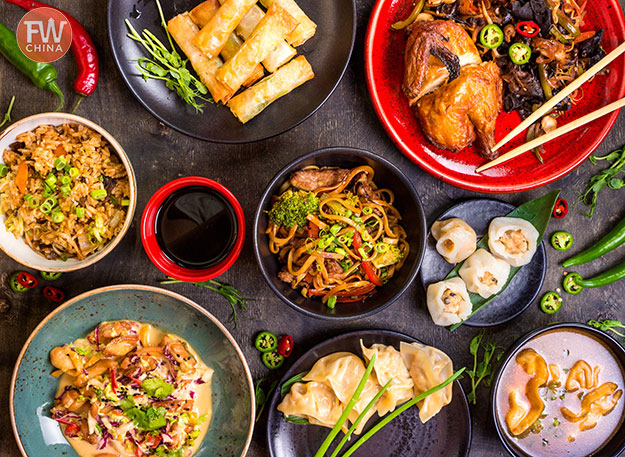
My experience with healthy Chinese food has been quite positive. Despite my aversion to diets, I’ve lost close to 10 kg (22 lbs) during my first year living in China.
A lot of this better health in China can be attributed to:
- More walking;
- A better sleep schedule;
- The occasional post-meal stomach virus I like to call Mao’s Revenge;
…but I think there was a little more at work here.
After a couple years living as an expat in China, I’ve come to the realization that although I was never officially on a diet, and I certainly wasn’t focused on eating healthy Chinese food options, I was definitely learning how to eat better.
Fact: Chinese People Eat Better
Let’s be clear about one thing: not all food in China can be considered healthy Chinese food. There’s plenty of junk food here too.
And China doesn’t always have a clear understanding of food either. Take this Chinese health notice I received about the 20 dangerous food combinations as a good example.
But in spite of all this, the Chinese people eat better than most Westerners like me do.
Most people I know tend to think that Chinese people are skinnier and generally healthier-looking because they eat healthy Chinese food.
But that’s not the real reason…
The Real Reason Chinese People are Healthier
The real reason that Chinese people are healthier has to do with their food culture.
It’s hard to understand food culture when you visit a Chinese restaurant back in the US, UK or Australia. The only thing you see is the food.
But the culture of food in China is what makes the food so appealing.
In my experience, I’ve seen four aspects of Chinese food culture that contribute to general health and make up for any lack of food nutrition.
1. China Uses Smaller Food Plates
I distinctly remember the first time I sat down to eat a plate of Xinjiang DaPanJi. This enormous dish of food was set down in the middle of the table…
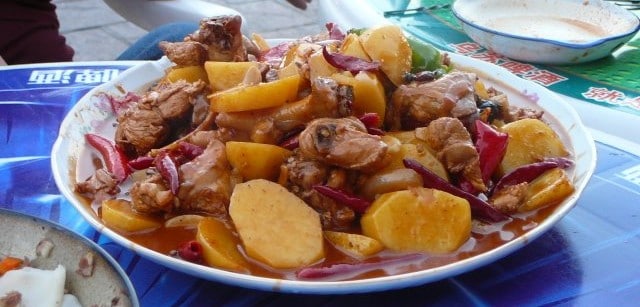
…and then each person was handed a plate the size of a Chinese mooncake (i.e. about 3-4 inches in diameter).
There were pieces of potato bigger than the plate I was eating off of!
I think I would describe the plate in China as serving two different functions:
- A pit stop between the dish and my mouth;
- A discard pile for bones and other things I don’t want to ingest.
Very rarely did a plate serve as my personal buffet.
Smaller plates promote smaller portions.
Obviously a small plate can’t stop me from gorging myself, which I still did on occasion.
But I did learn that I don’t feel quite as obligated to continue eating when my plate is often empty.

2. They Share Their Healthy Chinese Food
Instead of getting a plate of food just for themselves, most meals in China consist of multiple dishes spread out in the middle of the table for all guests to share.
At best, I’ll have my own bowl of rice, but that’s it.
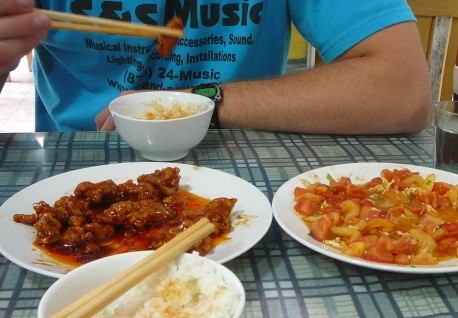
Sharing dishes at a Chinese restaurant is common and usually ends up decreasing the amount of food I consume.
Unfortunately western food doesn’t always lend itself to sharing but my wife and I have learned a simple lesson that has been both cost-effective and healthy…
We eat less when we share the table.
When going out to eat in America, we now tend to either split a plate (restaurants serve more than enough food on a plate nowadays!) or we get our own plates, split them and take half home as leftovers.
3. Chinese Meals Don’t Include a Dessert
Have you ever noticed that Chinese restaurants usually don’t have a desert menu? Or if they do, it’s full of obviously non-Chinese dishes?
It was both a shock and a disappointment to me when I first realized that Chinese food culture doesn’t serve dessert. Sure, a couple of them serve dishes of fresh fruit to end the meal but I think we can all agree that’s not most people’s idea of “dessert”.
It’s not mine, anyway.
Of course, China does have its own kind of Chinese sweets and candy, but it’s usually a street food and not a part of the meal itself.
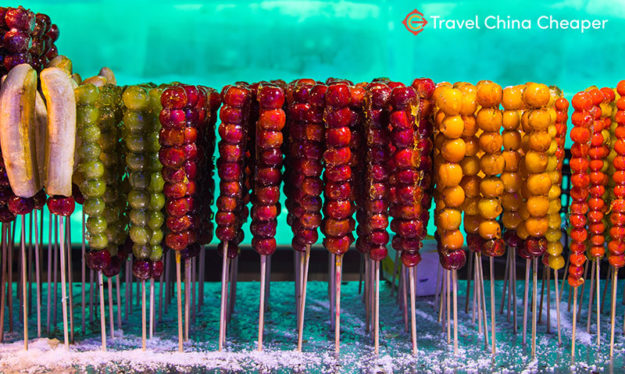
Sometimes my wife and I will treat ourselves to one of these treats as we walk home (walk, not drive)…but it’s a special occasion, not a mandatory meal course.

4. Chinese Meals Don’t Come with Refillable Drinks
Did you know that beverages account for almost 21% of the calories the average American consumes in a day?
Even outside America, I’m sure that number is quite high.
I come from a place where the cups are extra-large and the refills are free…I was NOT happy being served hot tea out of an 8oz. shot glass during meals.
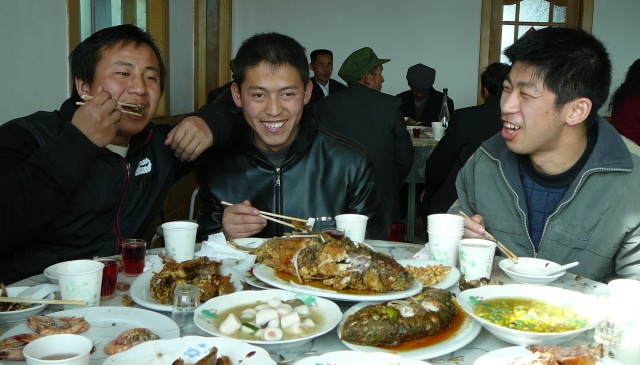
It was good for me, though. China helped me kick my habit of compulsive drinking.
I used go to a restaurant in America and tip a waiter based on how well my glass was kept full…and I worked them hard! Glass after glass of either Dr. Pepper (oh, such sweet nectar!) or iced tea, both of which contained more sugar than I probably needed for the entire week.
Is it all about healthy Chinese food? Maybe, but China helped me realize that my beverage consumption is important too.
5. Chinese Eat Slowly (Which is Healthier)
This seems like such a common-sense idea, yet somehow I fail to catch onto it. A banquet in China usually lasts a couple hours, with the food slowly rolling by on a lazy Susan.
Some Chinese officials I know have to go to a banquet every night…
…how do they survive?
I once sat next to a vice-mayor in our city during a banquet and asked her that exact question. Her response?
“Watch me…I’ll look like I’m eating but in reality I will eat very little tonight“.
Sure enough, she didn’t eat more than 10 bites throughout the entire banquet.
Eat slow…eat less.
This isn’t a mind-blowing revelation or anything, but I think that because I’m using chopsticks and because I’m reaching into the middle of the table to grab my food, I end up eating much slower than I do in America.
Final Thoughts | Healthy Chinese Food
Is there such thing as healthy Chinese food? You bet there is!
But is that the only reason why Chinese people are generally healthier? Absolutely not.
The Chinese culture of food contributes to a healthier style of eating. If you live in China, you start to feel it. For those who just visit a Chinese restaurant back in your home country…it might not be as obvious.